Design + AI
AI cannot Manufacture creativity
It can only copy, with strict rules and guidelines. Designers write the rules.
I am Julie Torrisi-Coffey, a Product Design leader. For the last year I have been thinking about what designing with AI
actually looks like at scale. Not the demo. The real system. Read on to see where I’ve landed.
Designers are not getting replaced. We are moving up the stack.
The Thesis
AI is a logic problem
The hard part of designing with AI is not the AI. It is defining the rules clearly enough that an agent can execute them without supervision, and knowing which decisions an agent should never be allowed to make.
An AI agent can be trained to understand a brand. It can be programmed to produce on-brand assets, follow a tone, respect a grid, choose a color from a token set. Once the rules are clear, it will not get tired and it will not break the system on a Friday afternoon.
The interesting question is not whether AI will design. It is what designers do once we are no longer the bottleneck for output. My answer: we move from making artifacts to writing the logic that produces them. We move from taste output to taste programmed.
The Shift
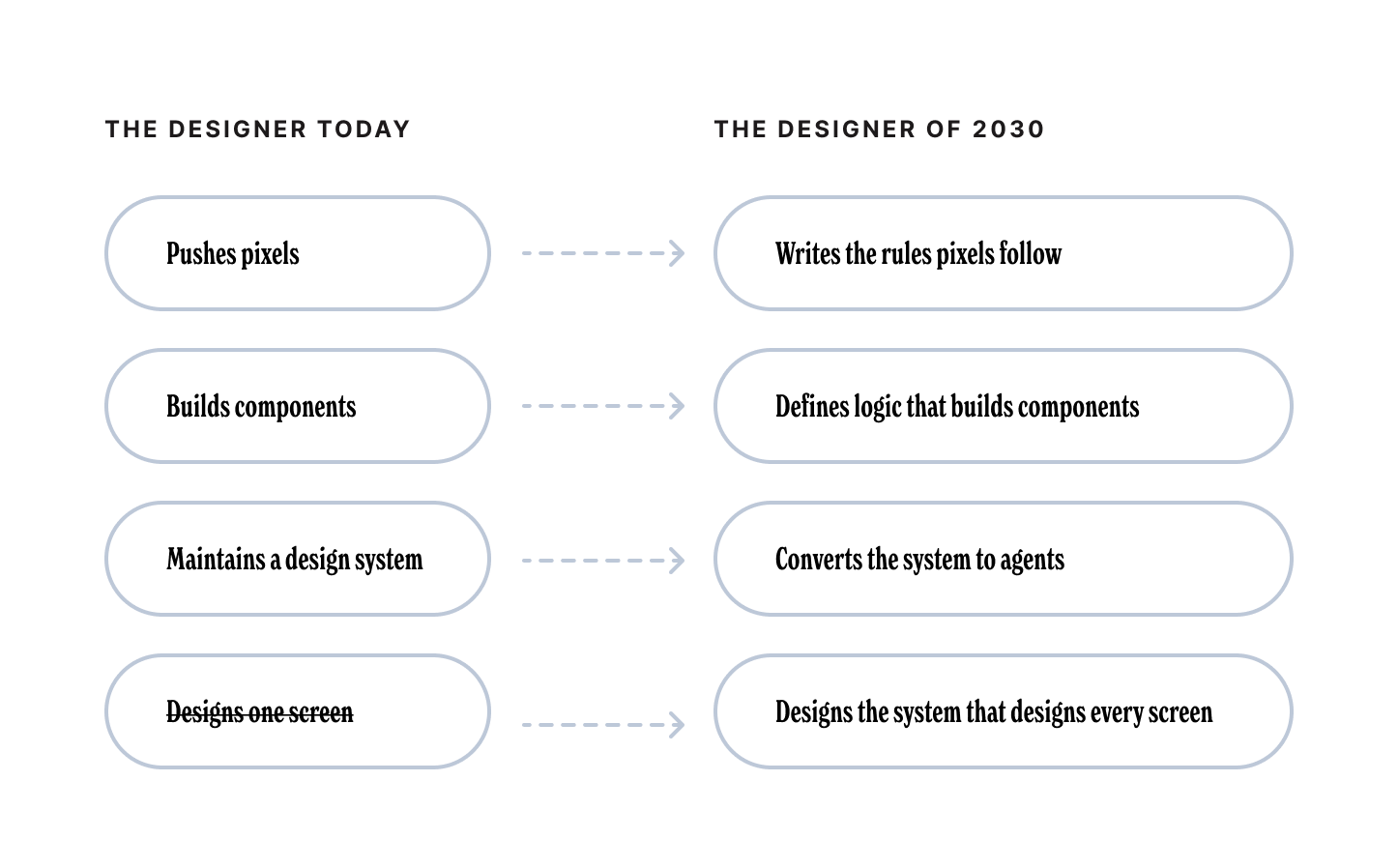
From pushing pixels to programming taste
This is the move I think every product designer in the next five years has to make. The work climbs the ladder. The artifacts change. The judgment does not.
The fun parts of design stay human. The mechanical parts get programmed.
The System
The agentic design loop.
Here is the system I would build if I were tasked with designing every permutation for a complex experience and validating which one earns trust.
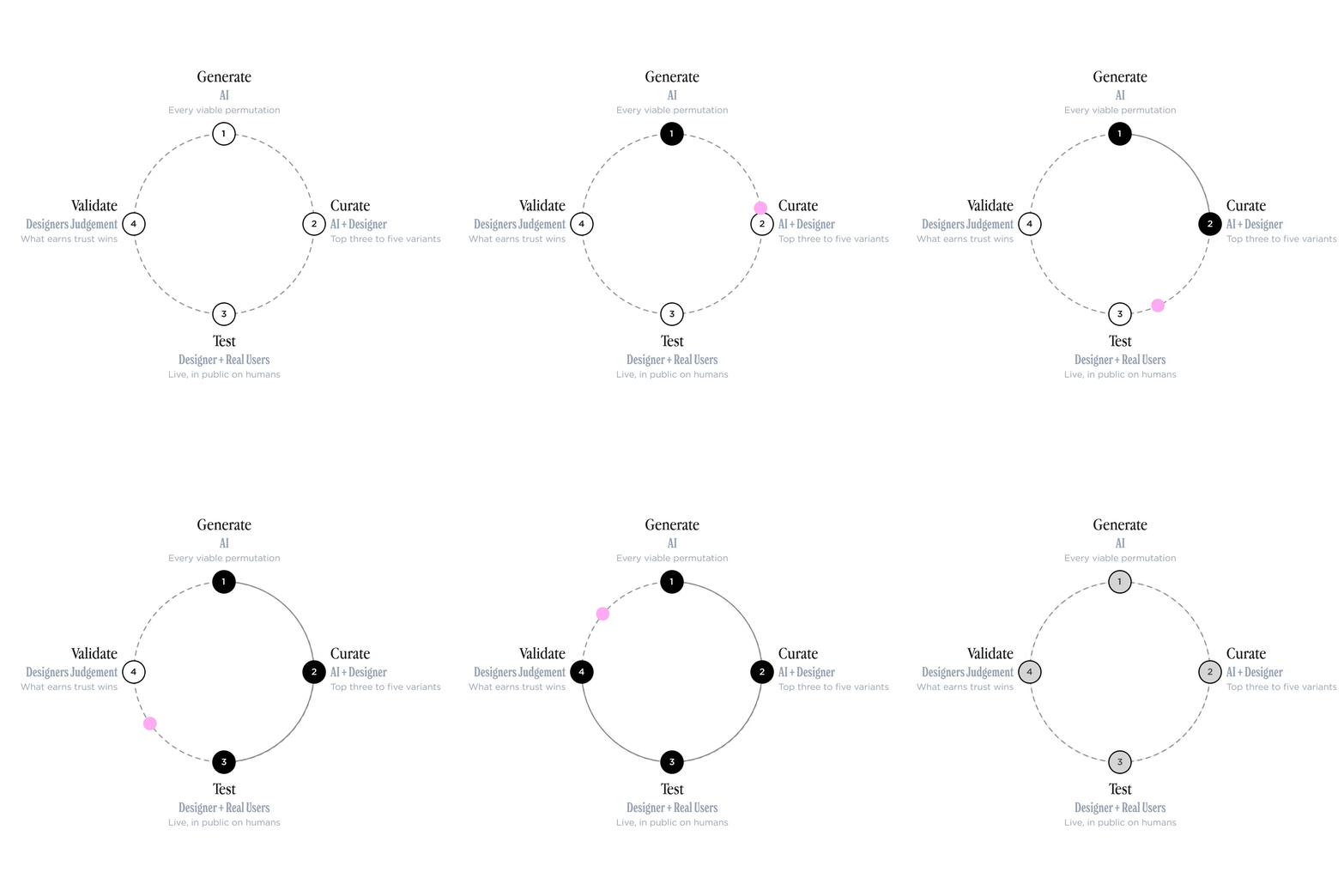
Permutations in. Trusted designs out. The target is always a human.
Design in practice
co-working with AI
01 Generate
Multiple agents, each tuned to a constraint (brand, accessibility, copy length, layout density), produce every permutation of the surface a real user could plausibly encounter. The volume is the point.
AI Generates permutations
DESIGNER Defines the constraints
02 Curate
A second-layer agent ranks against criteria the designer set: comprehension, accessibility, brand fidelity, novelty within bounds. The designer reviews the top tier and pulls three to five worth testing.
AI Ranks against rules
DESIGNER Sets the rules + edits
03 Test
Live testing on real people. Not a model. Not a synthetic user. A human who has a job, a deadline, and limited patience. This step is not optional and it is not delegable to an agent. The target is human.
AI Helps synthesize signal
DESIGNER Designs and runs the study
04 Validate
The winner is the one humans trust under load. The designer reads the result, decides what to ship, and folds the learning back into the rules the agents follow next round. The loop tightens.
AI Updates the ruleset
DESIGNER Decides what good means
My process
How I would convert a design system into AI agents that serve a team
This is the work I want to do next. Take a mature design system, the kind that already governs hundreds of surfaces, and turn it into a multi-agent infrastructure that augments a working design team. Not a chatbot. A system of small, specialized agents in conversation with each other, governed by rules the design team owns.
-
Read every token, component, pattern, and guideline. Find the contradictions. Resolve them. A design system that humans can fudge their way through is not a system an agent can execute. The first job is making it strict enough to be programmable, then writing it in a form a language model can reliably parse.
-
The system in the doc is half the system. The other half is the rules in designers' heads. Color Accessibility, why we never pair color X with color Y. Why this pattern is allowed at scale but not in this context. Surface these. Make them legible. This is the most undervalued part of the job and it is the part only a senior designer can do.
-
One agent for layout. One for tone of voice. One for accessibility. One for novelty within bounds. Each agent is small, testable, and replaceable. Each has a clear input, a clear output, and a refusal behavior for the things it should not decide.
-
The layout agent proposes. The voice agent edits. The accessibility agent vetoes. They argue with each other before a human sees the output. The interesting part is not any one agent. It is the protocol they use to talk.
-
Some decisions never go to an agent. New brand expression. A novel pattern. Anything involving a vulnerable user. Anything that defines the next direction of the product. Designers keep these. We name them out loud and we put them in the system.
-
Treat the agent system like a product. Instrument it. Log the calls. Review the outputs the designers reject and figure out why. The system gets better the same way a junior designer does, by being told no with reasons.
What Stays Human
The fun parts.
I want to be clear about which parts of design I think should never be delegated, because I think this is where my job stays interesting, and where the people I most want to work with also live.
-
An agent can score against a rubric. A designer decides what the rubric should measure. That decision compounds.
-
An agent can produce a thousand variations within a frame. It cannot decide the frame. The frame is a taste decision, and taste is information about humans that no current model has.
-
A user is angry. The product feels cold today. The team is burned out and pushing a feature they do not believe in. These signals never appear in training data. A designer who notices them is a designer who is worth their compensation.
-
The strongest design decisions I have ever made were cuts. Models do not cut. Models add. The cut is human.
If you are a designer reading this and you are nervous about AI taking your job, here is my honest read: the part of your job that you find boring is exactly the part that is going to get automated, and the part of your job that you find joyful is exactly the part that will define your career for the next decade. Move toward the joy.
Where I Think This is Going
Three predictions I am willing to defend
01
Within three years, every mature product design team will run on an internal multi-agent system. The team that builds it first will set the pattern everyone else copies. There is a directorship inside that work, and it does not exist on most org charts yet.
02
The designer's primary deliverable shifts from artifact to ruleset. Your portfolio in 2028 will not be screens. It will be the systems you built, the rules you wrote, and the agent behaviors you shaped. The case study format we use today will look quaint.
03
Live human testing becomes a differentiator, not a checkbox. When everyone can generate a thousand variations, the moat is knowing which one a real human prefers under real load. Research becomes core, not adjacent. Designers who can run their own studies will pull ahead.
“I am not afraid of AI doing design. I am afraid of design teams who do not learn to wield it before engineers do.”
— Julie Torrisi-CoffeyIf You Are Building This
Let’s Work Together
This is the actual work: building the agentic infrastructure that a product design team will run on for the next decade.